Junior Youth Empowerment Program
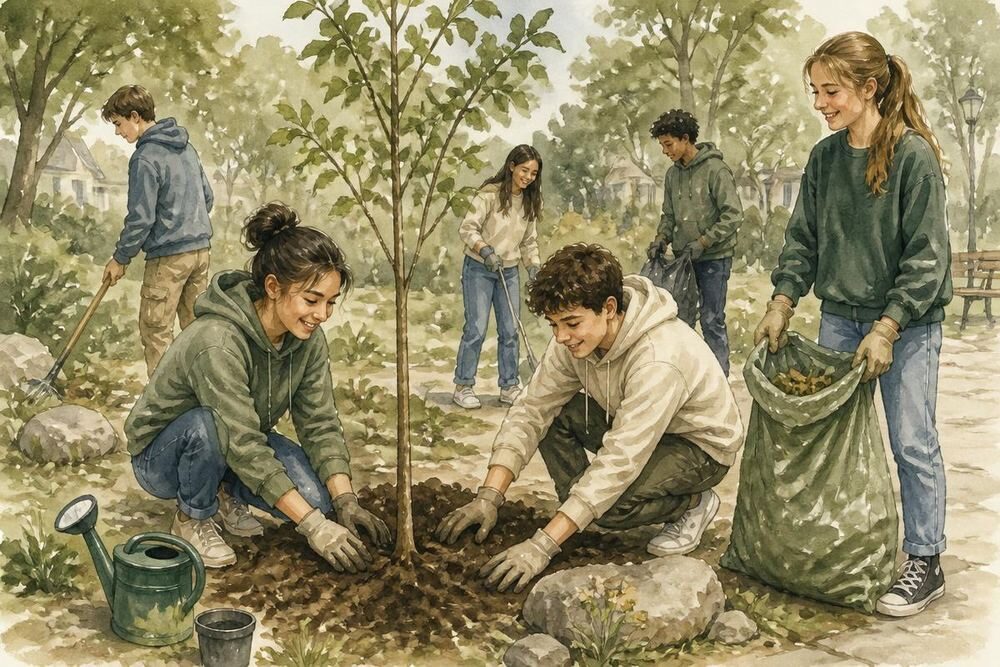
Between childhood and adulthood sits a decisive age. This programme gives 11 to 15 year olds the language, friendship and confidence to serve their neighbourhood.
Junior Youth Ages 11-15
The period between the ages of 11 and 15 represents a special time in every individual, where physical, emotional, intellectual & behavioral challenges take place. This age group is what we refer to as Junior Youth.
Various factors influence the way these young people think, act and behave including media, culture, environment, and familial upbringing. Junior youth are observant and often have many questions about the world around them and their role within it.
It is vital to assist these junior youth with recognizing the moral issues that underlie everyday decisions and to empower them to channel their abundant energies towards strengthening their own character. It is also vital that these junior youth understand the important role they can play in service to their community. In order to accomplish this we must engage them by capturing their interests using creative means and by employing interaction with older youth, who can serve as mentors and models through their actions and support.
What Are JY Groups & What Do They Do?
A junior youth group meets regularly with the purpose of fostering the moral and spiritual development of the junior youth in attendance. Meetings occur in a supportive environment that encourages individuals to share their thoughts and opinions while developing a deeper understanding of the topics covered.
The group is accompanied by an “animator”, an older youth or adult who offers gentle guidance and support in order to aid the group in accomplishing its goals. Together, the group studies materials from a curriculum which has been developed to introduce critical moral concepts while simultaneously enhancing the power of expression for each of the groups’ members. Each book has been developed to explore universal spiritual principles while uncovering an opportunity to learn about other cultural aspects from other areas around the globe.
Groups plan and engage in service projects and social activities that enhance community life, allowing them to put into practice the skills they have developed through study. As each group develops, the level and complexity of the groups’ activities grow along with their capacity to serve the community.
Who Can Become A Junior Youth Animator?
Anyone over the age of 15 is eligible to be a Junior Youth Animator. There is such a high demand to help Junior youth navigate this critical time period. There is a special connection between youth and young adults ages 15-30 when they choose to animate junior youth. To join the league of animators across the globe, just click on the Contact button at the top of the page and fill out the form in order to receive more information on how you can become an animator.
How Do I Sign Up For A Junior Youth Group?
To start all you need to do is click on the “Contact” button above and someone will contact you shortly. Remember to include your location. There are no costs or fees associated with joining the Junior Youth Empowerment Program, as it is sponsored and fully funded by the Baha’i community in your area.
What Books Will The Junior Youth Empowerment Group Be Studying?

Breezes of Confirmation
Themes: making an effort, truthfulness, friendship, and the confirmations that follow service.
Tells the story of Musonda, a young girl who has just turned 13 , and her older cousin Rose who has come to visit for the school holidays. A theme that runs throughout the story is that of making an effort and receiving God’s confirmations. While the book maintains a certain simplicity in terms of sentence structure and flow, there are many difficult words meant to challenge the reader. By placing such words in different contexts and drawing out their meaning through exercises, the text builds vocabulary and strengthens literacy skills. This book is most suited for junior youth aged 11 and 12.
Purchase The Book Download Illustrated Stories
Walking the Straight Path
Themes: moral reasoning through twenty short stories, vocabulary building, and memorisation.
Stories have traditionally been a means for conveying moral concepts from one generation to the next. The Badi Foundation in Macau draws on this tradition by bringing together twenty stories from different cultures in Walking the Straight Path. Each story is relatively short and followed by a series of exercises designed to further comprehension, build vocabulary, and enhance moral reasoning. Short quotations for memorization are also provided. The book is intended for young people aged 13 to 14.
Purchase The Book Download Illustrated Stories
Drawing On the Power of the Word
Themes: the power of expression, the moral weight of speech, and words that bring about social change.
This book seeks to enhance the power of expression and explore the moral implications of speech and action. It consists of twenty readings, each of which is complemented by exercises in language skills. The readings begin simply, but gain in complexity both in terms of thought and language. The first reading introduces Diego and his youth group, who live in the small town of Alegrías. With the help of a tutor from the nearby institute named Elisa, the group thinks about the power of enlightened words and pure deeds to bring about social change. The book is designed for youth aged 14.
Purchase The Book
Glimmerings of Hope
Themes: hope amid hardship, perseverance, and coherence between belief and action.
Glimmerings of Hope was written in response to the challenges faced by the many young people around the world living in the midst of civil strife. The book follows the story of Kibomi, a twelve-year-old boy who embarks on a journey to find his sister in another town after his parents are killed in their small village. Each lesson includes a set of questions and activities aimed at fostering the ability to understand the forces at work in society and developing coherence between belief and action. The book is designed for youth aged 11 to 13 or 14.
Purchase The Book
Wellspring of Joy
Themes: the true source of joy, clear expression, and living an integrated and fruitful life.
This book is designed to strengthen basic reading and comprehension skills and to develop, to some degree, the capabilities associated with articulating ideas with precision and clarity. The book tells the story of Saw Tu, a twelve-year-old refugee who is adjusting to life in his new country. Though he is experiencing difficulty at the outset of the story, he gradually comes to recognize where the source of true joy lies. It is hoped that those who study the text will, similarly, take the opportunity to reflect on this theme, one of many they will need to consider as they think about what it means to live an integrated and fruitful life. It is conceived of as one of the earlier texts in the series.
Purchase The Book
Habits of An Orderly Mind
Builds the habit of thinking clearly and in an orderly way: weighing ideas, spotting patterns and expressing thoughts with precision.
This book is the first text in the series to address mathematical and scientific concepts. It follows the discussions of a group of five friends who, with the help of the parents of two of the youth, explore what it means to have an orderly mind by thinking first about simple types of order, for example, the order inherent in the number system, and then gradually more complex ones, such as patterns found in nature. The final reading offers those who study the text an opportunity to reflect on some of the powers of the mind and how they can be employed for the good of humanity.
Learning About Excellence
Explores what it means to strive for excellence in study, work and service, and how high standards and humility go hand in hand.
In Learning About Excellence, a young girl, Ling Li, travels from the city to visit her grandparents in their village for the spring holidays. During her stay, she discusses with the members of her extended family aspects of city life and rural life and the possibilities for her future. Through these conversations, the book considers the intellectual and spiritual dimensions of excellence, its meaning in the domain of work, and its connection with adherence to high ideals, each lesson looking at one or more of the qualities and attitudes that contribute to its achievement. The book is usually taken up for study by youth following their completion of the initial texts in the series.
Thinking About Numbers
Strengthens mathematical thinking through stories and problems, showing how numbers help us understand the world and plan acts of service.
Thinking About Numbers follows the conversation of a group of classmates living in a small village in the Philippines who, with the help of their teacher, explore mathematical concepts such as accuracy, one-to-one correspondence, sets, and negative and irrational numbers. Over the course of their discussions, the group considers the application of these concepts to day-to-day life, investigating, as they do so, the meaning of justice, service, and progress. In this way, the book seeks to help young people not only further their capability of making numerical statements about the reality around them but also think about the social dimension of statements regarding the world. The book is envisioned as the third in the junior youth series that will discuss mathematical and scientific concepts.
Observation and Insight
Trains careful observation of the natural and social world, and the insight to draw meaning from what we see around us.
The story of Observation and Insight opens in Jalpura, an imaginary village in India, where twelve-year-old Nanda lives with her family. Over the course of eleven readings, she is helped by Kalpana, who runs a nearby educational center for women, and Ramnik, her brother-in-law who is an ecologist, to organize the insights she is gaining as she observes the world around her. Nanda is at an age where she is starting to ask herself questions not only about physical reality but also about social reality. In this connection, she is helped to think about the kind of changes that will need to take place in her small village if it is to achieve enduring prosperity. The book is envisioned as the fourth of several texts in the junior youth series that will address mathematical and scientific concepts.
The Human Temple
Looks at the human body and spirit as a temple: health, cleanliness, and the connection between physical well-being and spiritual life.
In a world where physical existence is given a great deal of emphasis, The Human Temple provides young people with an opportunity to consider in some depth the powers of the human spirit. The book, envisioned as one of the later texts in the series, takes its readers into the classroom of a teacher, Mr. Ian Scott, who helps his students to think about certain concepts related to language, addressing in this context such subjects as the power of human utterance and the nature of spiritual perception. The readings and exercises draw young people who study the text into a similar reflection, investigating with them those inner powers that distinguish the human being from all other things in creation.

Prayer for Youth
O Lord! Make this youth radiant, and confer Thy bounty upon this poor creature. Bestow upon him knowledge, grant him added strength at the break of every morn and guard him within the shelter of Thy protection so that he may be freed from error, may devote himself to the service of Thy Cause, may guide the wayward, lead the hapless, free the captives and awaken the heedless, that all may be blessed with Thy remembrance and praise. Thou art the Mighty and the Powerful.
~‘Abdu’l-Bahá
Come Join Our Junior Youth Groups
Learn more about Junior Youth Empowerment
Contact NowJunior Youth FAQs
Common questions from parents, young people and those thinking of serving as an animator.
Primary sources for the Baha'i writings quoted on this site are published in the Baha'i Reference Library.